
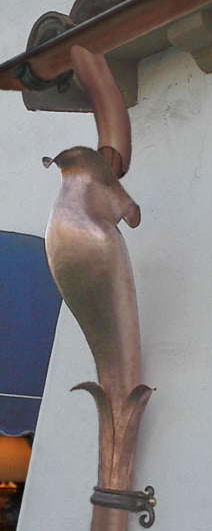
A heavy rain, flowing down house walls to the ground below, can cause a great deal of damage. At the very least, it taxes paint and wriggles into cracks, contributing to eventual, long-term decay. At its worst, it foils windows, invades walls and undermines foundations.
Gutters and drainage systems handle rainwater removal to keep these things from happening.
Gutters, long troughs that catch water at the eaves, slope slightly toward downspouts that pipe the water to the ground. Depending upon the drainage situation around the base of the house, water is then routed into below-ground drain pipes or other means of dispersing it away from the foundation.
To catch both runoff and ground water, perforated drain pipe, run in a gravel-filled trench, provides the path of least resistance for water. Pipe drops at a minimum slope of 1/2-inch per foot.
Avoid wet-weather damage to your home by cleaning your rain gutters twice a year.
During a rainstorm, gutters route runoff from a very large surface--a home's roof--to where it can drain away from the house. By doing so, they protect siding, windows, doors, and foundations from water damage and help prevent flooding in basements.
To do their job, gutters and downspouts must be clear of leaves and debris. If they aren't, drain outlets will dam-up and rainwater will fill the gutters, back up, overflow, and eventually pull gutters loose from their mountings. Water that pools in troughs will rot wood gutters and rust sheet metal ones.
You can hire a service to clean your gutters, but by doing the work yourself you can save $100 or more.Overview:
Plan to clean gutters at least twice a year--more often if the roof is directly beneath trees. But only take on this task yourself if you know you can work safely from a ladder or the roof. If your roof is higher than a single story or you're unsure of your job's safety, you're better off hiring a professional.
Choose a sturdy ladder and place it on a firm, level base. A tall stepladder can be easier to use than an extension ladder; if you must lean an extension ladder against a gutter, protect the gutter from bending by placing a short piece of 2-by-4 inside it. Stand on the ladder with your hips between the rails--don't lean out over the sides. Never stand on the top two rungs.
If you're comfortable working from the rooftop and your roof has a very low pitch, this can be easier than working from a ladder. But only do this under extremely safe conditions.
Never work on the roof in wet, icy, or windy conditions. Wear non-slip shoes and never lean over the edge or work near power lines.
When cleaning gutters, wear heavy work gloves to protect your hands. Gutters often have sharp metal parts or screw points sticking out into their troughs; take care to avoid cutting your hands. Also wear safety glasses or goggles.
The conventional method for cleaning gutters is discussed below. A method sometimes used by home handymen on low-sloped roofs is to blow dry debris out of gutters with a leaf-blower. If you use this method, wear goggles and a dust mask, and be very careful!
Leaf-catching gutter systems are highly touted by manufacturers, but most are not a complete solution. Debris eventually settles through them and the screens must be removed to clean out gutters. Some systems are very expensive. If you opt to buy a leaf-catching system, be sure it can be easily removed for cleaning.
1. Scoop out loose debris .
Starting at a drain outlet at the low end of a gutter, use a narrow garden trowel to scoop out loose debris, working away from drain outlet. It's usually easiest to do this when the debris is slightly damp and pliable--not soggy or dried and encrusted. To minimize cleanup later, you can scoop the debris into a plastic garbage can liner.
2. Blast out the gutters with a hose .
Using an on-off high-pressure nozzle mounted at the end of a water hose, wash out each length of gutter, working toward the drain outlet. This can be a messy job--avoid splattering mud all over your house. If necessary, use a stiff scrub brush to break loose encrusted dirt.
3. Clear obstructions in drainpipes .
If water doesn't drain freely through drainpipes, try flushing debris down them with the hose. If that doesn't work, use a plumber's auger (snake) to free and pull out debris from the bottom as shown. You can help keep the drainpipes free of debris by installing leaf strainers in at the tops (these are available at home-improvement centers and hardware stores).
4. Repair leaks.
If you see areas where water is leaking through seams between gutter sections, mark the leak locations with chalk, allow the gutter to dry completely, then seal the leaks from inside with gutter seal.
5. Re-align sagging gutters.
If gutters are not sloped properly at a pitch of 1 inch for each 20 feet of length, they won't drain properly toward downspouts. To support sagging gutters, bend or add new hangers, or add new fasteners.
Copper Rain Gutters;
Cast Bronze Raingutter Brackets (Raingutter Hangers) for Half Round Copper Gutters; Mitered and Spherical Gutter End Caps;
Radius Raingutters and cornices in any profile;
Goosenecks that follow an Elegant French Curve back to the wall;
Ornamental Leaderheads in Cast Bronze and Copper Sheet (Leaderheads are also called Collectors, Collector Heads, Scuppers, Scupper Heads, and Rainwater Heads);
Ornamental Cast Bronze Downspout Brackets (not just Copper Downspout Straps);
Smooth Drawn Elbows,
Downspout Water Chains;
Curved Radius Gutters in Halfround and Ogee, or any profile;
Installation services in and around Southern California.